

Mathematical Induction Iit Jee Questions Pdf
If n is a +ve integer, then 33n−26n−1 is divisible by
Solution:
For n=1, 33n − 26n − 1
= 33 − 27 = 0
For n=2, 33n− 26n − 1
= 36 − 52 − 1
= 729 − 53
= 676
If n is a +ve integer, then 23n−7n−1 is divisible by
Solution:
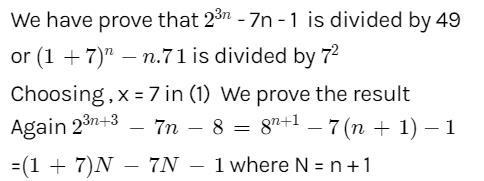
Which is divided by 49 by the case of above.
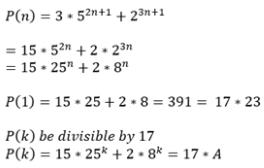
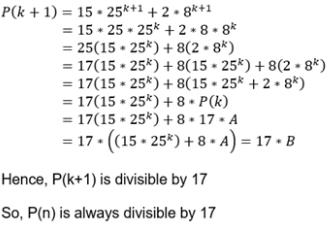
If n is a +ve integer, then 3.52n+1+23n+1 is divisible by
Solution:
If n is a +ve integer, then 72n−4 is divisible by
Solution:
For n = 1, 72n – 4 = 72 – 4 = 49 – 4 = 45
45 is not divisible by any of the options.
Let P (k) = 1 + 3 + 5 + …………….+ (2k – 1) = (3+k2).Then which of the following is true ?
Solution:
The inequality 2n<n!,n∈N is true for :
Solution:
For each n ∈ N,a2n−1+b2n−1 is divisible by :
Solution:
For each n ∈ N, n (n + 1) (2n + 1) is divisible by :
Solution:
n(n+1)(2n+1) is divisible by 6
Suppose P(n) : n(n+1)(2n+1)
P(1) : 1(1+1)(2(1)+1)
= 2(3) = 6
The statement is true for P(1)
The statement is true for P(m)
P(m) : m(m+1)(2m+1) is divisible by 6
P(m+1) : [(m+1)(m+1+1)(2(m+1)+1]
= (m+1)(m+2)(2m+3)
= (m+1) m(2m+1+2) + 2(m+1)(2m+3)
= m(m+1)(2m+1) + 2m(m+1) + 2(m+1)(2m+3)
6k + 2(m+1)(m+2m+3)
6k + 2(m+1)(3m+3)
6k + 6(m+1)(m+1)
= 6[k + (m+1)2]
P(m+1) is true for m+1
It is also true for all n,
n(n+1)(2n+1) is divisible by 6
For each n ∈ N, 3(52n+1)+23n+1is divisible by :
Solution:
For each n ∈ N, 23n−1 is divisible by :
Solution:
For each n ∈ N, 32n−1 is divisible by :
Solution:
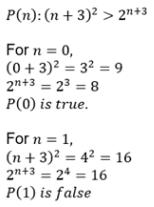
The statement P (n) : "(n+3)2> 2n+3 " is true for :
Solution:
The smallest positive integer 'n' for which 2n(1×2×3×...............×n) < nn holds is :
Solution:
If 10n+3×4n+1+k is divisible by 9 for all n ∈ N, then the least positive integral value of k is
Solution:
The smallest positive integer n, for which ( 1 × 2 × 3 ×……×n ) 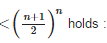
Solution:
Let P(n) : n2−n+41 is a prime number . then :
Solution:
Let that P(n) ⇒ P(n+1) for all natural numbers n. also, if P (m) is true, m ∈ N, then we conclude that
Solution:
Consider the statement P (n) : "n2≥ 100 ". Here P(n) ⇒ P(n+1) for all natural numbers n. Does it mean
Solution:
The smallest positive integer 'n' for which P (n) : 2n< (1×2×3×............×n) holds is :
Solution:
If xn−1 is divisible by x – k for all n belongs to natural numbers N, then the least positive integral value of k is :
Solution:
A student was asked to prove a statement P (n) by method of induction. He proved P (k + 1) is true whenever P (k) Is true for all k ≥ 5 , k ∈ N and P (5) is true. On the basis of this he could conclude that P (n) is true
Solution:
If P(a) is true and truth of P(n) implies that P(n+1) is also true, then, we can conclude that P(n) is true for all n≥a where n∈N.
Here, P(5) is true.
Hence we can conclude that P(n) is true for all n≥5
If a,b,c ∈ N, an+bn is divisible by c, when n is odd but not when n is even, then the value of c is :
Solution:
1.2.3 + 2.3.4 + 3.4.5 + ………..up to n terms is equal to :
Solution:
nth term = n(n+1)(n+2); where n=1,2,3,…
= n(n2+3n+2) = n3 +3n2 +2n
Sum =n(n+1)/2 ; if nth term =n
= n(n+1)(2n+1)/6 ; if nth term =n2
= n2(n+1)2/4 ; if nth term =n3
Hence the required sum =
n2(n+1)2 /4 + 3 ×n(n+1)(2n+1)/6 +2 × n(n+1)/2
= n2 (n+1)2 /4 +n(n+1)(2n+1)/2 + n(n+1)
= n(n+1) {n(n+1)/4 + (2n+1)/2 +1}
= n(n+1) {(n2 + n + 4n + 2 + 4)/4}
= 1/4 n(n+1){ n2 + 5n + 6}
= 1/4 n(n+1)(n+2)(n+3)
The number of terms in the expansion of (x+y+z)n is
Solution:
Number of terms is equal ton+r-1Cn
For (x+y+z)n
r = 3
Hence number of terms are n+3-1Cn
= n+2Cn
= ((n+2)!)/2!n!
= [(n+1)(n+2)]/2
The sum of the terms in the nth bracket of the series 1 + (2+3+4) + (5+6+7+8+9) ….is
Solution:
Mathematical Induction Iit Jee Questions Pdf
Source: https://edurev.in/course/quiz/attempt/-1_Test-Principle-Of-Mathematical-Induction-2/5df2e136-de7d-42f3-b6fb-711b34e9d786
Posted by: mackwently99.blogspot.com
0 Response to "Mathematical Induction Iit Jee Questions Pdf"
Post a Comment